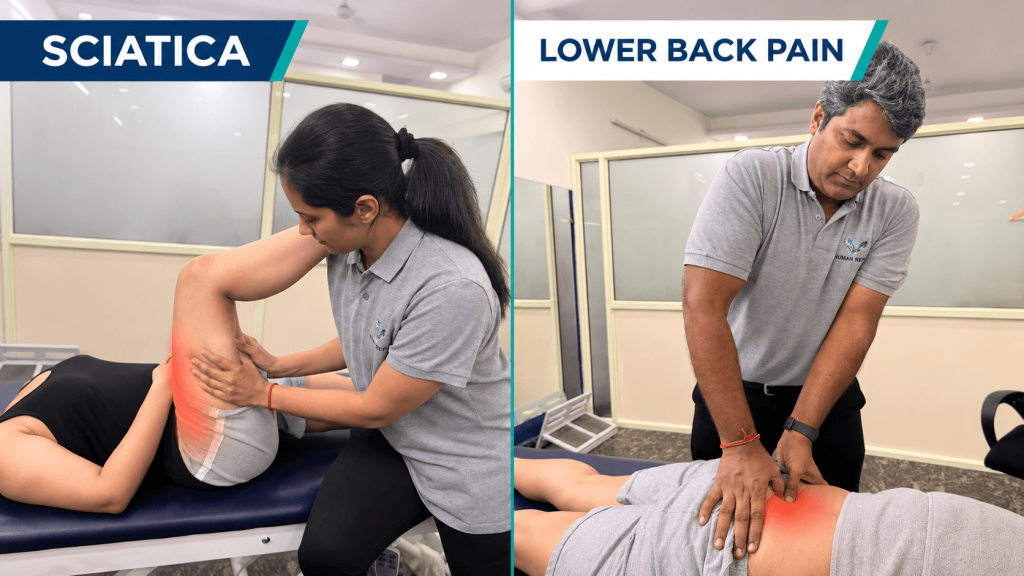
An ache in your lower back after a long day. A pulling sensation in your buttock. A sharp pain travelling down your leg.
Do these symptoms mean lower back pain, sciatica, or something else?
Understanding the difference helps you make sense of your treatment. When you know what we are assessing, why a particular technique or exercise has been selected, and what changes to look for, you can participate more confidently in your recovery.
At Human Repair, this understanding is part of our approach. Through the five pillars of Integrated Functional Therapy™—Holistic Assessment, Myofascial Release, Joint Play, Posture Training and Therapeutic Exercises—we build an individual treatment plan with lasting relief as the goal.
What Is the Difference Between Sciatica and Lower Back Pain?
Lower back pain describes discomfort around the lower spine. Sciatica describes a pattern of nerve-related symptoms that typically travels into the buttock and down a leg.
| Feature | Lower back pain | Sciatica |
| Where you feel it | Mainly the lower back; sometimes the buttock or thigh | Buttock and leg, sometimes reaching the foot |
| How it may feel | Aching, stiffness, tightness or sharp discomfort | Shooting, burning or electric-like pain |
| Tingling or numbness | Less typical in uncomplicated back pain | May occur |
| Muscle weakness | Not typical of uncomplicated back pain | Can occur when nerve function is affected |
Sciatica can occur with very little back pain. However, pain travelling into the leg does not automatically confirm sciatica—an examination helps distinguish it from other causes. NHS
Why Similar Symptoms May Need Different Treatment
Two people may both say, “My back hurts when I sit,” yet need different treatment plans.
One may mainly experience stiffness and reduced tolerance for prolonged sitting. Another may develop tingling down the calf, suggesting that nerve function also needs assessment.
Your symptoms provide clues, but we also need to understand:
- When the problem began and how it has changed.
- Which movements aggravate or ease it.
- Whether symptoms stay in one area or travel.
- How your back, hips and surrounding regions move.
- How work, sleep, activity and previous injuries affect your daily function.
We explain how these findings relate to your treatment, including where there is uncertainty. You should understand the purpose of your care rather than simply receive a list of instructions.
How We Use the Five Pillars of Integrated Functional Therapy™
Integrated Functional Therapy™ provides the framework for your care at Human Repair. The assessment determines how we use each pillar; the combination and intensity are adapted to your symptoms and response.
1. Holistic Assessment: Understanding Your Symptoms in Context
We begin by listening to your experience and identifying what you want to return to—whether that is sitting comfortably at work, sleeping better, walking farther or exercising again.
The examination may include your spinal and hip movements, walking pattern, functional tasks and relevant muscle testing. When nerve involvement is suspected, we also assess sensation, strength and other neurological signs.
We then explain our working understanding of the problem and the reasons behind the proposed treatment.
What this means for you: You leave with a clearer picture of your symptoms, your starting point and the goals we will work towards together.
2. Myofascial Release: Addressing Relevant Soft-Tissue Discomfort
Pain may be accompanied by tenderness, muscle guarding and uncomfortable movement around the back, buttocks or hips.
Where appropriate, we use myofascial release to address these findings and assess whether it helps you move more comfortably. We explain which area we are treating and why it matters to your symptoms or function.
Soft-tissue treatment does not physically push a disc back into place or establish that a nerve has been decompressed.
What this means for you: Any improvement in comfort becomes an opportunity to practise the movements and exercises selected for your recovery.
3. Joint Play: Assessing and Supporting Comfortable Movement
Joint play involves assessing the small movements available within a joint and using selected mobilisation techniques when appropriate.
Depending on your examination, we may consider the spine, hips or other relevant regions. We reassess your symptoms and movement afterwards to judge whether the technique is useful for you.
We also explain why a joint away from the painful area may be assessed, without assuming that every restriction is responsible for your pain.
What this means for you: You understand what the hands-on treatment is intended to achieve and how its effect will be evaluated.
Manual therapy should be used within a broader programme that includes exercise, rather than as a stand-alone approach. NICE
4. Posture Training: Making Everyday Activities More Manageable
Posture training at Human Repair considers how you sit, stand, bend, lift and move throughout your day.
The aim is to find practical options that suit your symptoms and responsibilities. Your plan might include adjusting your workstation, changing positions more often, modifying a lifting task or gradually rebuilding tolerance for sitting.
We explain which changes are temporary strategies during a painful phase and which habits may remain useful as you recover.
What this means for you: You have practical ways to apply your treatment at home and at work.
5. Therapeutic Exercises: Building Capacity Beyond the Session
Your exercise programme connects treatment in the clinic with the activities you want to regain.
Depending on your findings, it may include comfortable mobility work, trunk and hip strengthening, walking progression, movement practice or selected nerve-mobility exercises.
We explain:
- What each exercise is intended to improve.
- How much to do and how often.
- What response is acceptable for you.
- When to modify an exercise or contact us.
- How the programme will progress.
For someone returning to household tasks, the focus may be comfortable bending and lifting. For someone returning to the gym, it may include gradually rebuilding strength and tolerance for load.
What this means for you: Your home programme has a clear purpose and a realistic place in your daily routine.
Why Understanding Your Treatment Matters
An instruction such as “do these exercises daily” can be difficult to follow when you do not know why they matter.
We want you to understand the connection between your symptoms, assessment findings and treatment. That makes it easier to discuss concerns, practise correctly and tell us when something needs adjusting.
For example, knowing that a movement is intended to improve your walking tolerance gives you a meaningful goal to monitor. Knowing which symptom changes to report helps us review your programme sooner.
This shared understanding is how we aim to support better consistency and recovery. Your role is active, and our role includes making the plan understandable and achievable.
How We Work Towards Lasting Relief
We track progress beyond the pain you feel immediately after a session.
Can you sit through more of your workday? Walk farther? Sleep more comfortably? Return to activities with greater confidence?
We reassess these goals and adjust treatment accordingly. As your capacity improves, your programme should progress too.
Lasting relief is our goal, although recovery varies and cannot be guaranteed. We work towards it through an appropriate combination of treatment, education, exercise and strategies you can continue using independently.
Do You Need an MRI Before Treatment?
An MRI is not routinely necessary for every episode of lower back pain or sciatica. Imaging is generally considered when its findings are likely to change management.
Your assessment also helps determine whether medical referral or further investigation is appropriate. NICE
When Should You Seek Urgent Medical Care?
Seek emergency assessment for new bladder or bowel difficulties, numbness around the genitals or bottom, symptoms in both legs, or severe or worsening leg weakness or numbness.
These symptoms can indicate a serious nerve problem. Do not wait for a routine clinic appointment. NHS
Understand Your Symptoms. Take an Active Part in Your Recovery.
If back or leg pain is affecting your work, sleep or movement, an assessment can help clarify what is happening and what treatment is appropriate.
At Human Repair, we use the five pillars of Integrated Functional Therapy™ to connect assessment, hands-on care, everyday movement and progressive exercise. Throughout treatment, we explain what we are doing, why we are doing it and how you can support your progress.
Integrated Functional Therapy™
Not a technique. A system.
Book your assessment: 9821145658
Human Repair: L-50, Saraswati Garden, Mansarovar Garden, New Delhi 110015
humanrepair.in